Robotic Jellyfish Installation
This is an electromechanical installation which uses a linear delta kinematic system to control the motion of a jellyfish shaped floating object in 3 dimensions within the exhibition space.
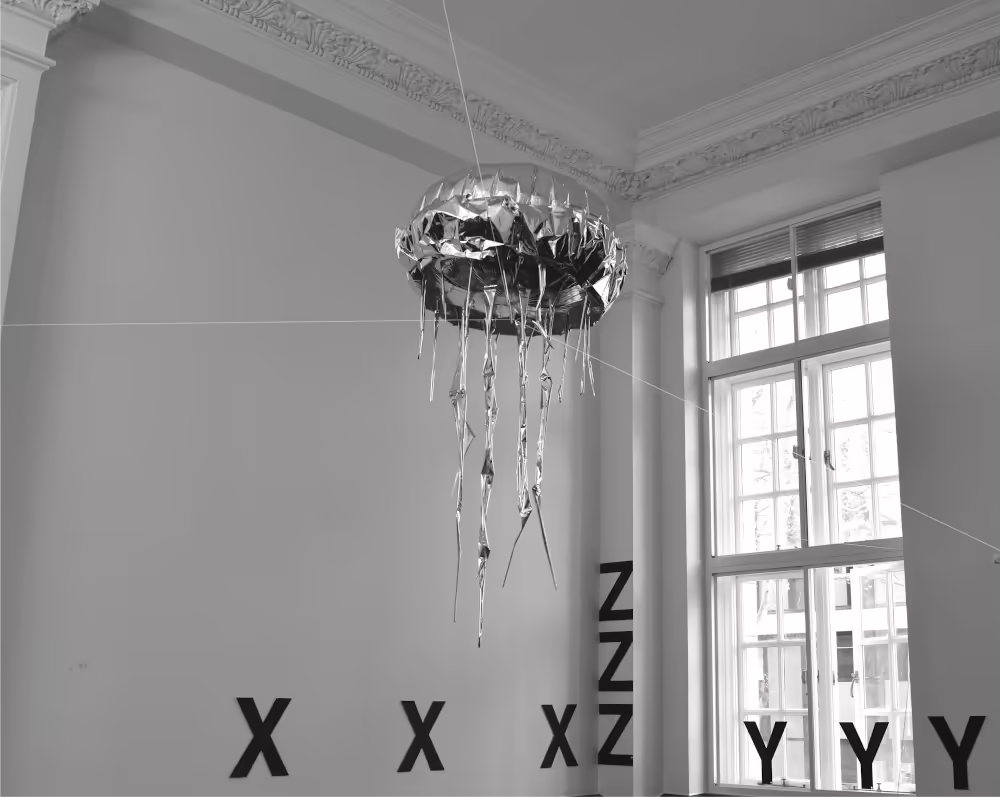
The original goal of this project was to develop an immersive installation for which multiple visitors could interact simultaneously. Touch sensitive capacitive letters attached to the wall were intended to control the motion of the jellyfish and generated sound effects. However due to development time limitations, the exhibited version included the jellyfish following a randomised path along with a separate work-in-progress version of the touch sensitive letters and sound system.
System design
The jellyfish floating object is made from a 1 metre diameter helium filled balloon with additional foil pieces attached. Three nylon strings are attached to the base of the balloon which hold it in position.
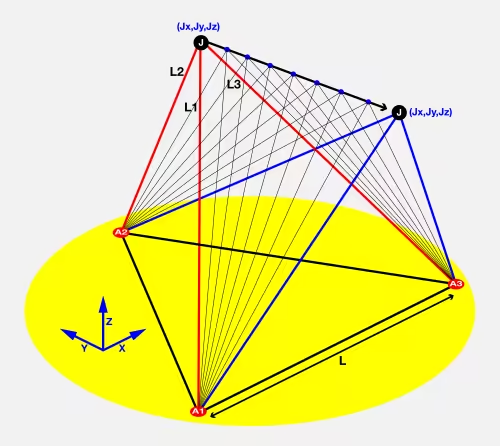
The nylon strings are routed through 3 wall mounted attachment points arranged in a triangle from which they are redirected to a single base station. The base station contains three stepper motors with spools around which the nylon strings are wound. The control PCB accurately controls the rotation of each of the motors.
Operation principal
The length of the 3 tethers is changed by the winding or unwinding of the spools. Each position in the operational volume has a corresponding set of three lengths. To move the jellyfish from one position to another specified in terms of cartesian coordinates, intermediate points along the trajectory are first calculated. For each of these, the corresponding tether lengths can be calculated and spool rotation to achieve this length. Executing the movement is then a case of iterating though each set of spool rotation angles, rotating each spool from its current position to the next in fixed timesteps.
Specifications
| Manufacturing methods | 3D printing, laser cutting, electronics soldering |
|---|---|
| Development tools | Solidworks (CAD), iCircuit (schematic design), Arduino IDE |
| Main materials | System: 3 x NEMA 17 stepper motor, HC05 Bluetooth Module, foil balloon, Helium, Nylon thread, PLA, 5mm Neodymium magnets. Motor controller PCB: Strip board, solid core wire, ICs including A4988 stepper motor drivers; Arduino nano; 8v regulator; passives. Touch sensitive letters: Mountboard, Bareconductive paint, Audio FX board, Adafruit capacitive breakout board. |
| Exhibited | Dyson School of Design Engineering Open House 2019.03 |